
Most businesses will not collapse because of recession, competition or lack of effort.
They will disappear because AI economies no longer reward operational competence alone.
The invisible crisis has already begun.
Editorial Note
This week on The High Valuation Code, Francisco Gaffney and I explored a subject that most founders are still psychologically avoiding:
Why profitable businesses are becoming economically invisible.
Not bankrupt.
Not necessarily loss making.
Not obviously failing.
Invisible.
Because the architecture of value has changed faster than leadership teams realise.
For decades, businesses were protected by geography, relationships, distribution advantages and information asymmetry. The industrial economy rewarded execution capacity. The digital economy rewarded scale.
The AI economy rewards something else entirely:
Institutional relevance.
And that distinction changes everything.
The Silent Collapse Happening Inside Profitable Businesses
Most founders still believe profitability protects them.
It does not.
A business can produce revenue, employ staff and maintain healthy margins while simultaneously becoming strategically obsolete.
This is the new paradox of the AI economy.
A company may appear operationally successful while structurally collapsing underneath.
The market no longer rewards effort alone.
It rewards scalability without friction.
Transferability without dependency.
Visibility without constant founder intervention.
This is why two businesses with identical EBITDA can receive completely different outcomes from banks, investors and acquirers.
One becomes desirable.
The other becomes replaceable.
The difference is architecture.
AI Is Compressing Competitive Advantage
The uncomfortable reality is this:
Average execution is becoming free.
Marketing can be generated.
Research can be automated.
Content can be replicated.
Customer support can be scaled infinitely.
Software development is accelerating dramatically.
AI is commoditising competence itself.
This creates what I describe as the great commoditisation event.
And most businesses are entirely unprepared for it.
Because many founders still believe that working harder creates defensibility.
It does not.
In AI-driven economies, the market increasingly rewards businesses that are:
• systemised
• institutionally structured
• IP-rich
• globally relevant
• operationally transferable
• psychologically investable
The market punishes businesses dependent on founder energy.
The Dangerous Illusion of Growth
One of the greatest misconceptions in modern business is that growth automatically creates value.
In reality, growth often magnifies fragility.
A founder may celebrate rising sales while simultaneously increasing:
• operational dependency
• customer concentration risk
• delivery chaos
• cashflow volatility
• leadership bottlenecks
• execution fatigue
AI accelerates this exposure.
Weak systems become visible faster.
Weak leadership becomes visible faster.
Weak positioning becomes visible faster.
This is why many businesses will experience what appears to be “sudden decline” over the next decade.
But the collapse will not actually be sudden.
It will be structural deterioration that remained hidden until AI accelerated the market’s ability to detect weakness.
Why Investors Hesitate Even When Businesses Perform Well
Founders often misunderstand what investors truly buy.
Investors do not fund effort.
They fund certainty.
That certainty comes from institutional architecture.
When investors assess businesses today, they increasingly ask:
Can this scale without founder exhaustion?
Can this survive leadership transition?
Can systems replace dependency?
Can intellectual property compound advantage?
Can AI improve margins structurally rather than tactically?
Can this business become globally relevant?
These questions matter because AI has changed the benchmark itself.
Businesses are no longer compared merely against competitors.
They are compared against automated scalability.
And that is a completely different valuation framework.
The High Valuation Triangle
This is precisely why I developed the High Valuation Triangle years ago.
Because valuation is no longer driven purely by financial outputs.
It is driven by structural design.
The three pillars remain:
Intellectual Property Monetisation
Succession Architecture
Global Relevance
Together, they determine whether a business becomes:
• bankable
• investable
• scalable
• transferable
• acquirable
Without these pillars, AI economies push businesses toward commoditisation.
And commodities compete on price.
Price competition eventually destroys both margins and valuation.
The Founder Extinction Risk
Many businesses today are unknowingly trapped in what I call the founder dependency cycle.
The founder drives:
sales,
strategy,
delivery,
relationships,
operations,
problem solving,
decision making,
visibility,
momentum.
This model can survive temporarily.
But it cannot compound institutionally.
The market increasingly rewards businesses where value survives independently of the founder’s daily intervention.
That transition is no longer optional.
It is becoming existential.
Fail. Pivot. Scale.
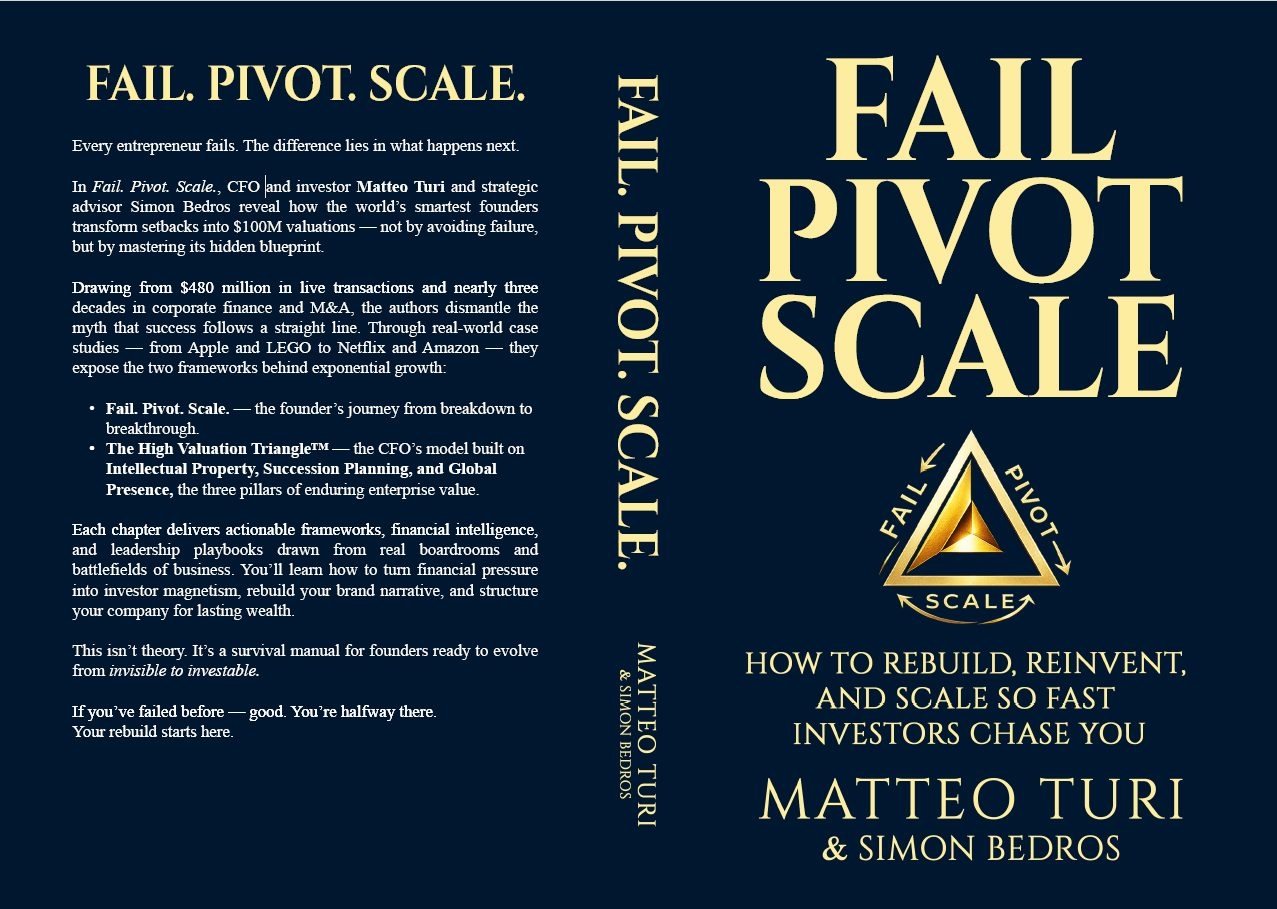
This is why the title of my book matters more now than ever.
Fail. Pivot. Scale.
Most businesses are already in the “Fail” stage structurally.
Not because they are collapsing financially.
But because the current model no longer compounds competitively in AI economies.
“Pivot” means redesigning the architecture itself.
Not buying another AI tool.
Not posting more content.
Not chasing productivity hacks.
Real structural redesign.
Then, and only then, does “Scale” become valuable.
Because scaling weakness simply accelerates collapse.
AI magnifies both intelligence and fragility simultaneously.
The New Question Every Founder Must Answer
For years, founders asked:
“How do I grow my business?”
The more important question now is:
“Why would the market notice my business at all?”
Because visibility is becoming engineered.
The future belongs to businesses that become impossible to ignore.
Not through noise.
Not through vanity metrics.
But through institutional design.
That is the real valuation game now.
The 12 Outcomes in 49 Days
This is the reason behind the High Valuation Sprint.
The objective is not motivation.
It is transformation.
The 12 Outcomes are designed to move businesses from operational survival toward strategic visibility by helping founders become:
• bankable
• capital attractive
• AI ready
• systemised
• globally relevant
• IP monetised
• operationally scalable
• valuation focused
Because in the AI economy, businesses will increasingly split into two categories:
Those that become magnets for capital.
And those that slowly disappear into invisibility.
The middle ground is shrinking rapidly.
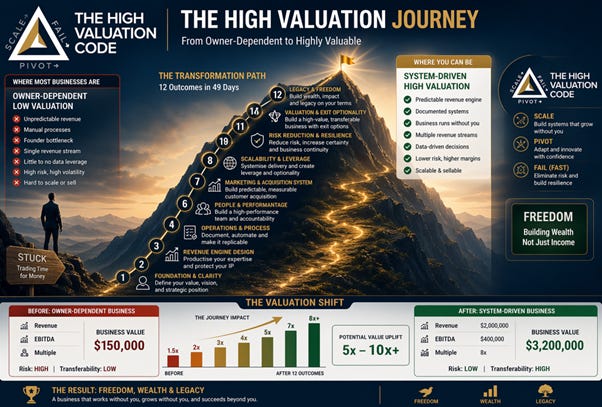
Find your current position through the High Valuation Scorecard below.
About Matteo Turi
Matteo Turi is a CFO, Valuation Architect and author of Fail. Pivot. Scale..
Over nearly three decades, he has worked across startups, scale-ups, crisis situations, restructurings and international growth environments, helping businesses transition from operational survival toward institutional value creation.
His work focuses on a central belief:
That most businesses are still being managed using industrial-era logic while competing inside AI-driven intangible economies.
Through frameworks such as the High Valuation Triangle and the High Valuation Sprint, Matteo’s work centres on helping founders build businesses that become:
• bankable
• fundable
• scalable
• transferable
• strategically visible
Rather than treating finance as historical reporting, his approach positions valuation as a form of architecture.
An engineered system combining:
cashflow predictability,
intellectual property,
AI integration,
leadership scalability,
institutional governance,
and global positioning.
Matteo is also the creator of The High Valuation Code and The Exponential Blueprint, educational platforms focused on helping founders understand how modern markets now reward structural design more than effort alone.
His work increasingly focuses on one urgent reality:
In AI economies, businesses will not be rewarded merely for working harder.
They will be rewarded for becoming impossible to replace.


