
90% of Your Company’s Value Might Be Invisible
If someone bought your business tomorrow, what exactly would they be buying?
Your revenue?
Your team?
Your client relationships?
Or something deeper.
Here is a number that should make every founder and CFO pause.
In the 1970s, about 83% of the value of the S&P 500 came from tangible assets.
Factories. Machinery. Buildings.
Today that number has flipped.
Around 90% of the value of the S&P 500 is intangible.
Not physical.
Not visible.
Not always recorded on the balance sheet.
Which raises an uncomfortable question.
If 90% of value in modern markets is intangible…
How much of your company’s value is actually visible to capital?
Because capital can only price what it can see.
And invisible value is discounted value.
A Quick Question for You
(Substack poll)
Where do you believe most of your company’s value currently sits?
• Revenue and profitability
• Brand and reputation
• Intellectual property and systems
• Customer relationships and contracts
• I am honestly not sure
The Part of Your Business That Is Rarely Measured
When people hear the term intellectual property they often think about patents.
But patents are only a small fraction of the story.
The most valuable intellectual property in most companies is operational.
It lives inside the way the business works.
Your pricing model.
Your sales methodology.
Your customer acquisition system.
Your operational playbooks.
Your data insights.
Your proprietary frameworks.
These elements rarely appear clearly on the balance sheet.
But they determine whether a company trades at three times EBITDA or ten times.
Investors do not buy effort.
They buy systems.
They are not paying for how hard the founder works.
They are paying for what survives when the founder steps away.
And this is where many companies lose enormous value.
The Reality Check
Many founders believe they are undervalued.
Often they are.
But the reason is rarely what they think.
The problem is not effort.
The problem is structure.
From the inside, the founder sees expertise.
Years of experience.
Deep market understanding.
Operational knowledge.
From the outside, investors see risk.
Is the process documented?
Is the advantage defensible?
Is the revenue transferable?
If the answer is unclear, the multiple compresses.
Even when the business is profitable.
Even when growth is strong.
Because capital prices certainty.
And certainty comes from architecture.
The Effort Trap
There are two types of businesses in the world.
The first sells effort.
The second sells assets.
Effort based businesses rely on continuous human input to generate revenue.
Asset based businesses convert knowledge into systems that scale beyond individuals.
Consultancies become licensing models.
Agencies become platforms.
Expertise becomes methodology.
Operational insight becomes intellectual property.
The companies that make this transition often experience something extraordinary.
Their revenue may not change dramatically.
But their valuation multiple does.
The IP Monetisation Engine
Over the years I have noticed a pattern.
Most businesses already possess more intellectual property than they realise.
The challenge is not creation.
It is recognition and structure.
A simple five step framework reveals the opportunity.
First identify where knowledge creates advantage.
Second codify that knowledge into frameworks and systems.
Third protect it through contracts, ownership clarity or legal protection.
Fourth embed it into revenue models.
Fifth align it with long term exit strategy.
Once intellectual property is connected to revenue and transferability, valuation begins to change.
Before that it remains invisible.
Three Forces Changing the Valuation Game
This shift toward intangible value is not slowing down.
It is accelerating because of three powerful catalysts.
Artificial Intelligence Is Rewriting Productivity
AI is doing to knowledge work what electricity once did to industry.
It multiplies output.
But it also compresses advantage.
If knowledge is not structured into systems, AI accelerates commoditisation.
Expertise without architecture becomes easy to replicate.
Intangible Assets Now Dominate Global Markets
Around 90% of S&P 500 value now comes from intangible assets.
Markets reward systems more than infrastructure.
Data more than buildings.
Brand more than machinery.
If your company cannot articulate its intangible architecture, investors assume it does not exist.
Global Capital Is Expanding Rapidly
Between now and 2030, global private capital markets are expected to expand by roughly $10 trillion.
Private equity.
Private credit.
Family offices.
Sovereign wealth funds.
Capital is not disappearing.
It is multiplying.
But it is becoming more selective.
It flows toward businesses that demonstrate structural clarity and defensible advantage.
Not just growth.
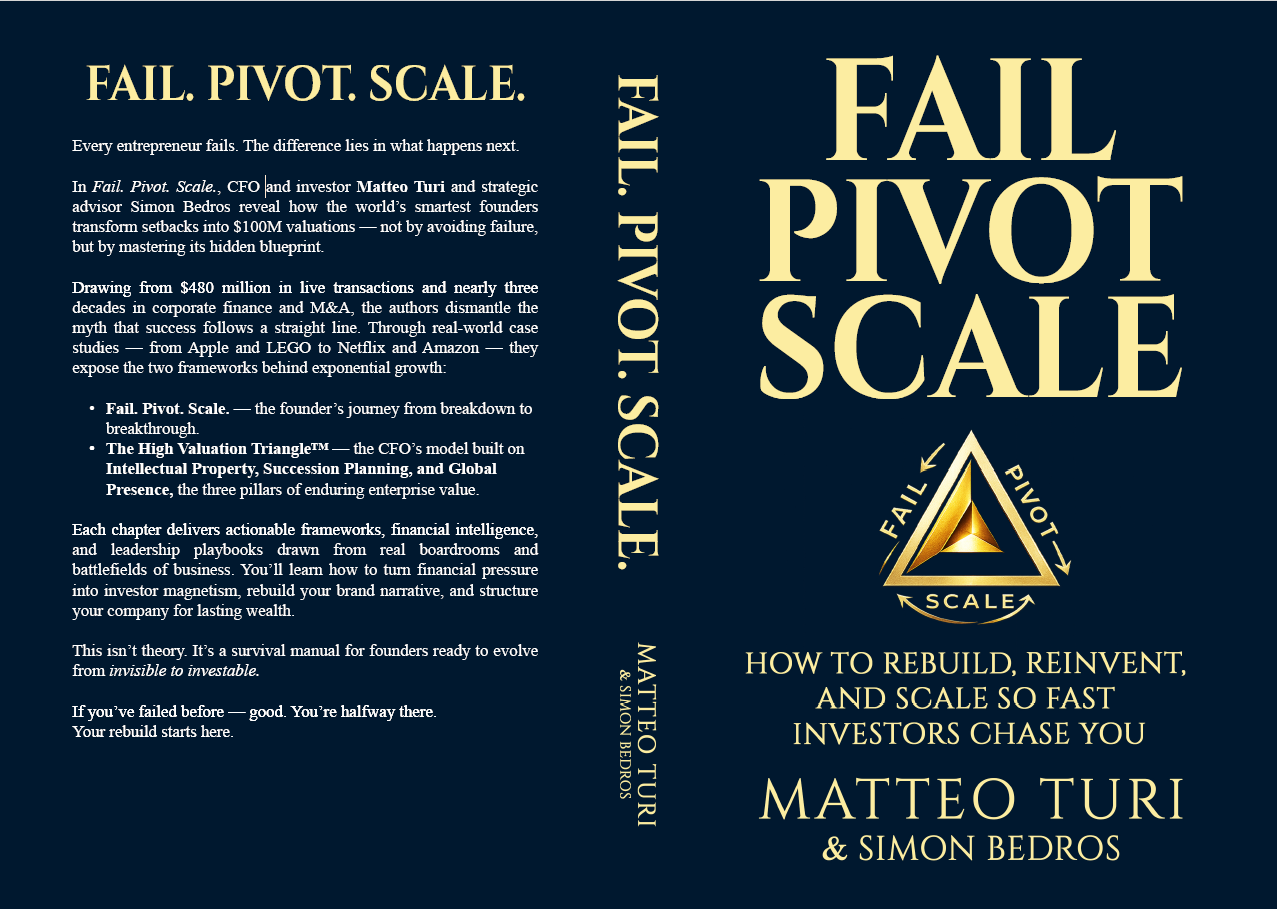
Why I Wrote Fail. Pivot. Scale.
Watching these forces converge led me to a simple conclusion.
Many companies are not undervalued because they lack performance.
They are undervalued because they lack architecture.
Strong businesses eventually discover the same cycle.
First they recognise structural weaknesses.
Then they redesign the architecture of the company.
Only then do they scale confidently.
Fail.
Pivot.
Scale.
Inside the book I introduced 26 valuation scorecards designed to help founders and finance professionals diagnose the structural strength of their businesses.
Each scorecard tests a critical dimension of valuation architecture.
Fundability.
Intellectual property.
Revenue durability.
Governance.
Capital structure.
Exit readiness.
Because what can be measured can be improved.
And what can be improved can be valued.
This Week on The High Valuation Code Live
This Wednesday we explore this topic live.
The High Valuation Code
90% of Your Value Revealed
We will discuss:
Why intellectual property often hides inside operational processes
Why accounting frequently under-reports real value
How the IP Monetisation Engine unlocks hidden valuation
Why codified knowledge increases valuation multiples
If you are a founder, CFO or finance professional responsible for capital, growth or governance, this conversation matters.
Because the most valuable part of your business may be the part you have never formally mapped.
And capital can only price what it can see.
About Matteo Turi
Matteo Turi is a CFO and board director who helps founders and finance leaders design businesses that attract capital and command premium valuations.
His work focuses on three structural drivers of value.
Intellectual property monetisation.
Succession and leadership depth.
Global scalability.
Together these form the High Valuation Triangle.
Because valuation is not a number.
It is structural confidence.


