
Editor’s Note
This week marks the final episode of the first 13-week cycle of The High Valuation Code with Francisco Gaffney.
Over the past three months, we have discussed intellectual property, governance, capital structures, AI, succession planning, investor psychology and valuation mechanics.
But beneath every conversation sat a deeper truth.
Businesses do not become valuable by accident.
They become valuable by design.
And in the coming AI-driven economy, that distinction may determine which companies attract capital and which quietly disappear.
There is a dangerous misconception spreading through the entrepreneurial world.
It says that valuation is a number.
It is not.
Valuation is a system.
And most businesses are structurally unprepared for the system that investors now reward.
For decades, founders were taught that growth alone would eventually create enterprise value. Increase sales. Improve profit margins. Hire more people. Expand geographically. Raise capital.
But the rules of the game have changed.
Financial statements are no longer sufficient to explain business quality.
That sentence alone should terrify finance professionals.
Because we are entering an economy where the most valuable assets increasingly sit outside traditional accounting frameworks.
Intellectual property.
AI systems.
Data architecture.
Revenue predictability.
Transferability.
Operational leverage.
Decision velocity.
Brand ecosystems.
Platform effects.
Founder independence.
These are now the variables driving enterprise valuation.
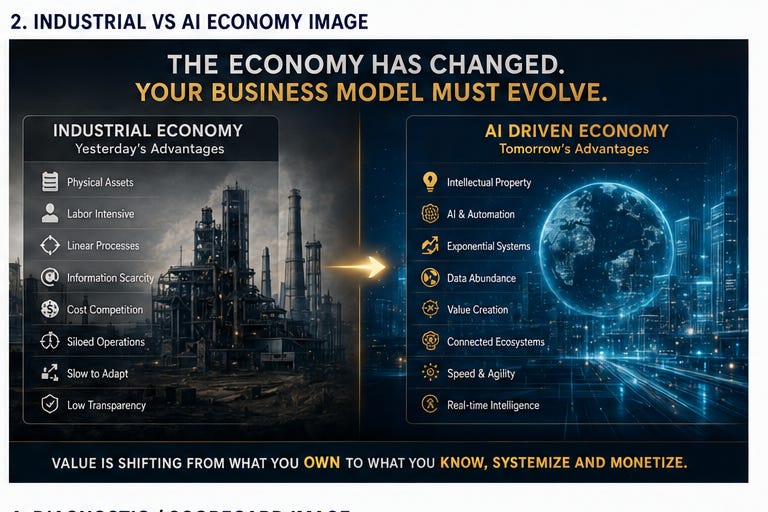
The S&P 500 was once dominated by tangible assets. Factories. Machinery. Inventory. Buildings.
Today, nearly 90% of enterprise value is intangible.
And yet most private businesses are still managed as if it were 1975.
That disconnect is becoming one of the greatest wealth destruction events in modern business history.
Because capital has changed.
Investors no longer simply buy performance.
They buy predictability.
Defensibility.
Scalability.
Transferability.
Optionality.
They buy systems.
And that is precisely where most founders become exposed.
Many businesses still depend entirely on founder energy.
The founder sells.
The founder approves.
The founder negotiates.
The founder decides.
The founder solves crises.
The founder holds relationships.
The founder carries operational memory.
In other words, many businesses are not companies.
They are employment structures disguised as companies.
And sophisticated buyers know this immediately.
Which is why many founders receive disappointing offers despite years of sacrifice.
The valuation gap is rarely emotional.
It is structural.
This is why I built the High Valuation Triangle.
Not as a motivational framework.
Not as branding.
Not as consulting language.
But as financial architecture.
Three forces now determine whether a company becomes magnetic to capital in the AI economy:
Intellectual Property Monetisation
Succession Planning & Leadership Scalability
Global Relevance & Transferability
Together, these create leverage.
And leverage changes everything.
Because leverage changes negotiation power.
Leverage changes investor psychology.
Leverage changes deal structure.
Leverage changes multiples.
Most founders focus on increasing revenue.
Sophisticated founders focus on engineering valuation conditions.
That is a completely different discipline.
It is the difference between building a business and designing an asset.
And this distinction is becoming brutally important because AI is accelerating the separation between structured companies and founder-dependent companies.
AI is not replacing businesses.
AI is exposing weak architecture.
This is why Gartner continues to report that a large proportion of AI projects fail.
Not because the technology fails.
Because the underlying business is not operationally ready.
You cannot automate chaos.
You cannot scale confusion.
You cannot multiply weak systems with AI and expect enterprise value to emerge.
The companies that dominate the next decade will not necessarily be the companies with the best AI.
They will be the companies with the strongest valuation architecture.
That is why I introduced the concept of:
12 Outcomes in 49 Days
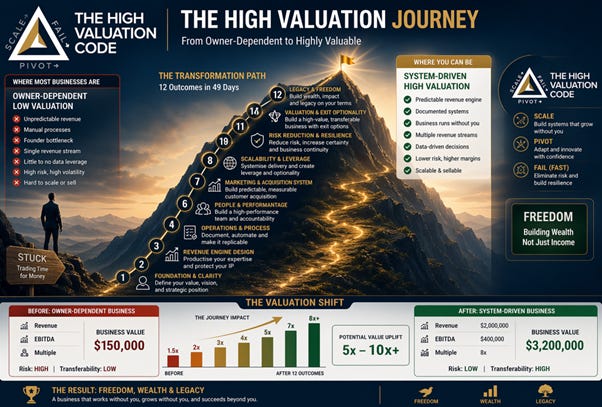
Because transformation must become measurable.
Businesses need operational outcomes that reposition them structurally for the new economy.
Not theory.
Not inspiration.
Not vague strategy decks.
Outcomes.
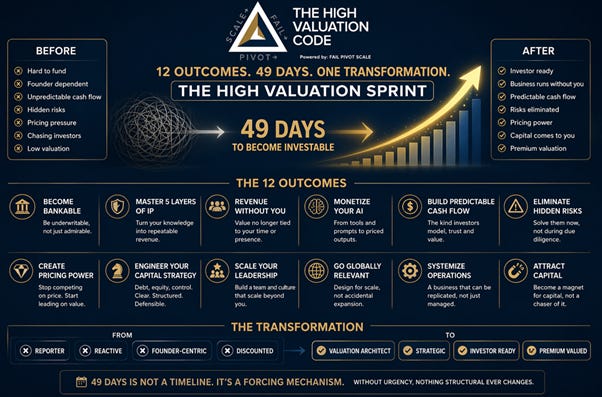
The 12 outcomes are designed to move businesses from fragile to investable.
From founder-led to scalable.
From reactive to predictable.
From operationally heavy to systemically valuable.
Including:
• Becoming bankable
• Creating predictable cash flow
• Monetising intellectual property
• Reducing founder dependency
• Engineering pricing power
• Building leadership scalability
• Structuring global relevance
• Designing operational systems
• Becoming magnetic to capital
This is not productivity optimisation.
This is enterprise re-engineering.
And the timing could not be more important.
Over the next decade, trillions of dollars of private capital will continue searching for scalable, structured, AI-compatible businesses.
Yet most founders still do not understand how investors actually think.
Investors do not simply ask:
“How profitable is this business?”
They ask:
“How transferable is this business?”
“How predictable is this business?”
“How dependent is this business?”
“How defensible is this business?”
“How scalable is this business?”
“How survivable is this business without the founder?”
That is valuation psychology.
And it explains why two businesses with similar revenues can receive radically different valuations.
One sells a company.
The other sells future certainty.
That difference can represent millions.
This is also why I wrote Fail. Pivot. Scale..
Despite the title, the book was never really about failure.
It was about valuation blindness.
Inside are 26 scorecards designed to expose the structural weaknesses that eventually destroy enterprise value during due diligence.
Weak governance.
Unclear IP ownership.
Revenue fragility.
Operational dependence.
Lack of transferability.
Weak systems.
Leadership concentration risk.
Because by the time the negotiation starts, the valuation was already decided.
The buyer is simply discovering what the founder failed to structure earlier.
That is the uncomfortable truth.
And the founders who understand this earliest will become disproportionately advantaged in the next decade.
Not because they work harder.
But because they build differently.
The AI economy will not reward busyness.
It will reward architecture.
The next generation of wealth will not belong to those who merely generate revenue.
It will belong to those who engineer valuation systems.
That is the real shift now taking place beneath the surface of the economy.
And most businesses still cannot see it.
Applications now open
Applications are now open for the next 12 Outcomes in 49 Days cycle.
Only 12 businesses are accepted per quarter.
Because structural transformation requires implementation, not passive consumption.
If your business disappeared from operations for 30 days, would value continue to exist without you?
That question may define the next decade of enterprise valuation.
Below is link to the scorecard.
Find out how you score against the 12 outcomes.


