
Editorial Note
Most entrepreneurs spend their lives chasing assets they believe they do not have.
More customers.
More capital.
More staff.
More technology.
More time.
Meanwhile, they ignore the most valuable asset already sitting inside their businesses.
Not on the balance sheet.
Not in the bank account.
Not in the warehouse.
But hidden in plain sight.
Intellectual property.
And as artificial intelligence reshapes the global economy, that oversight may become one of the most expensive mistakes a business can make.
The great valuation migration
For most of the twentieth century, value was tangible.
Factories created value.
Machinery created value.
Inventory created value.
Balance sheets told most of the story.
Today they tell only a fraction of it.
The modern economy has undergone one of the largest wealth migrations in history.
Value has moved from physical assets to intangible assets.
Brands.
Data.
Processes.
Networks.
Software.
Systems.
Knowledge.
The world’s most valuable companies are not necessarily those with the largest buildings.
They are the ones with the strongest intellectual property.
Yet many small and medium-sized businesses continue to operate as though this shift never happened.
They still view intellectual property as something reserved for pharmaceutical companies, technology giants or patent lawyers.
They could not be more wrong.
The hidden asset class
Most businesses possess intellectual property.
The challenge is that few recognise it.
A pricing methodology is intellectual property.
A customer onboarding system is intellectual property.
A sales process is intellectual property.
An operational workflow is intellectual property.
A unique method of solving a customer problem is intellectual property.
A proprietary AI workflow is intellectual property.
A repeatable framework that consistently produces results is intellectual property.
The question is not whether a business possesses IP.
The question is whether it understands its commercial value.
The difference between a business and an asset often comes down to documentation.
If knowledge remains trapped inside the founder’s head, it is labour.
When that knowledge becomes repeatable and transferable, it becomes intellectual property.
And intellectual property scales.
AI changes everything
Many commentators argue that artificial intelligence will commoditise expertise.
There is some truth in that.
Generic knowledge is becoming abundant.
Routine work is becoming automated.
Content is becoming easier to create.
Information is becoming cheaper.
But that is only half the story.
As generic capability becomes abundant, uniqueness becomes scarce.
And scarcity attracts value.
AI can create content.
It cannot easily replicate decades of proprietary experience.
AI can write copy.
It cannot replicate unique customer relationships.
AI can generate code.
It cannot replicate a business’s accumulated operational intelligence.
The easier it becomes to generate average outputs, the more valuable exceptional intellectual property becomes.
This may become one of the defining valuation dynamics of the next decade.
Why investors care
Many founders assume investors are primarily interested in growth.
Growth matters.
But investors care even more about transferability.
Can the business operate without the founder?
Can the system be replicated?
Can success be repeated?
Can knowledge be transferred?
Can competitive advantage survive?
These questions all point toward intellectual property.
Investors are not simply buying current revenue.
They are buying future certainty.
The stronger the intellectual property, the greater the confidence that success can continue.
This is one of the reasons two businesses with identical revenue can receive dramatically different valuations.
One has built assets.
The other has built activity.
Capital recognises the difference immediately.
The High Valuation Triangle
Throughout my career as a CFO, board director and valuation strategist, I repeatedly observed the same pattern.
The businesses commanding premium valuations typically excelled in three areas.
First, they monetised intellectual property.
Second, they built succession and leadership structures that reduced dependency on founders.
Third, they developed international relevance and scalability.
These three elements became what I call the High Valuation Triangle.
Most businesses focus exclusively on growth.
The highest-valued businesses focus on architecture.
Growth follows.
Valuation follows.
Capital follows.
From invisible to investable
The challenge for founders is not creating value.
Most create value every day.
The challenge is converting invisible value into investable assets.
This requires a shift in thinking.
From working in the business to building systems.
From selling expertise to packaging expertise.
From solving problems to documenting solutions.
From creating value once to monetising it repeatedly.
The businesses that master this transition become fundamentally different organisations.
They become easier to scale.
Easier to finance.
Easier to acquire.
And significantly more valuable.
Fail. Pivot. Scale.
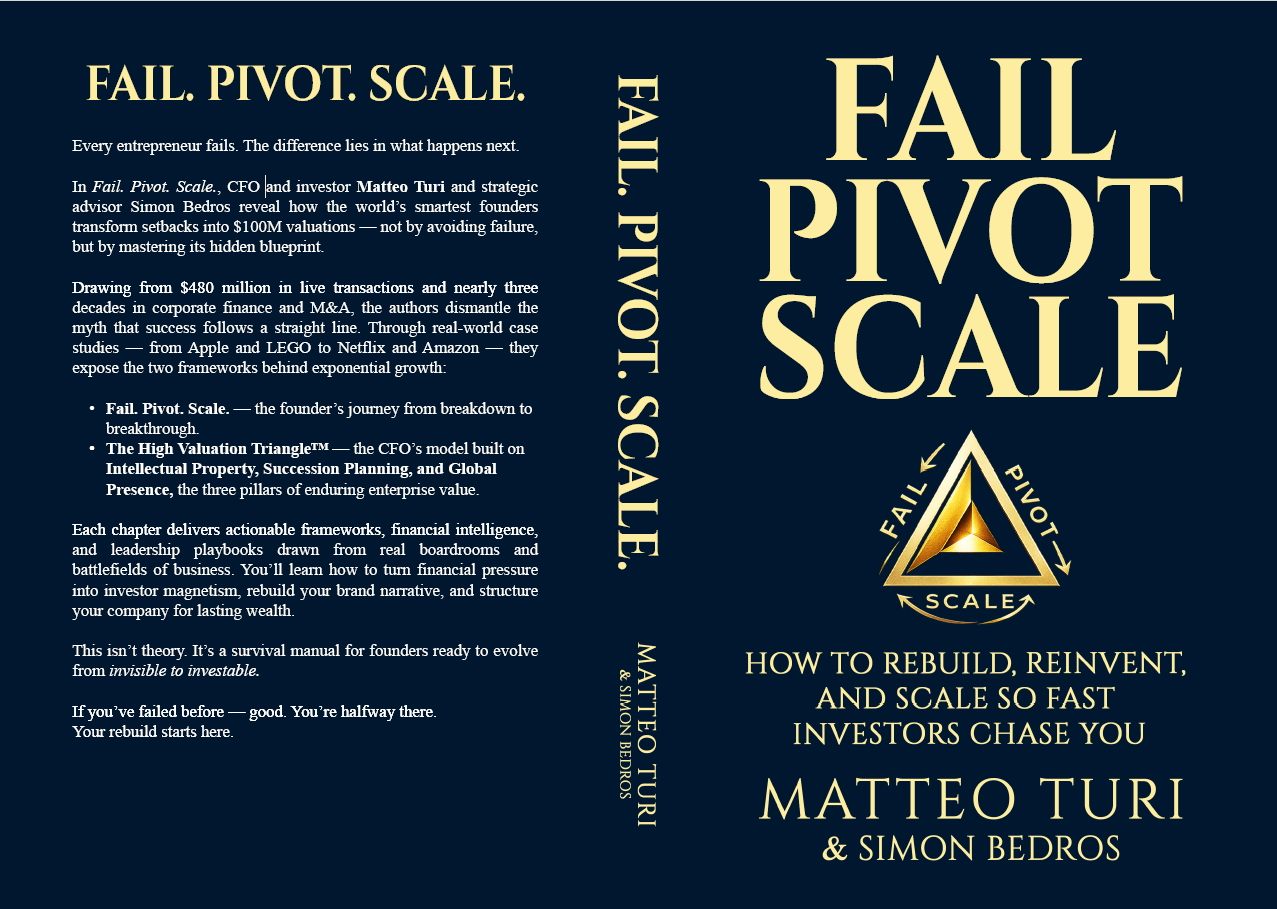
One of the reasons Simon Bedros and I wrote Fail. Pivot. Scale. was to address this blind spot.
Too many entrepreneurs are sitting on assets they cannot see.
They possess frameworks, methods, processes and knowledge capable of generating extraordinary value.
Yet because those assets remain undocumented and unmonetised, they never appear in the valuation conversation.
The result is predictable.
Businesses work harder.
Competitors catch up.
Valuations stagnate.
Capital hesitates.
The tragedy is not a lack of value.
The tragedy is invisible value.
That is why we created the 26 scorecards embedded throughout the book.
And why I continue to share the 12 Outcomes in 49 Days diagnostic framework.
Because before you can increase valuation, you must first identify where value already exists.
The businesses that dominate the next decade may not be the largest.
They may not even be the fastest growing.
They will be the businesses that learn to transform knowledge into assets, assets into systems and systems into valuation.
The future belongs to those who can see what others overlook.
And today, the most valuable thing in your business is probably invisible.
Matteo Turi
Author, Fail. Pivot. Scale.
Creator of the High Valuation Triangle


