
A silent economic reset is underway. Artificial intelligence is changing how businesses scale. Intangible assets now dominate corporate value. And trillions of dollars in private capital are searching for scalable, transferable companies. Yet many businesses, particularly across Europe, still operate using industrial-era assumptions built for a different century. Fail. Pivot. Scale. was written to confront that reality directly.
Editorial Note
This is a special edition of The Exponential Blueprint dedicated to the release of Fail. Pivot. Scale. by Matteo Turi and Simon Bedros.
The book was not written as motivational business literature.
It was written as a response to a structural economic shift already underway.
Because many businesses are still trying to compete in a world that no longer exists.
The rules have changed.
Most have not noticed yet.
The Economy Has Quietly Changed
For much of the twentieth century, business value was relatively tangible.
Factories.
Machinery.
Real estate.
Inventory.
Physical distribution.
Scale came from owning physical infrastructure.
But over the past several decades, the global economy has shifted dramatically toward intangible value.
Software.
Brands.
Algorithms.
Data.
Networks.
Intellectual property.
Operational systems.
Knowledge infrastructure.
Today, most enterprise value inside the world’s largest companies no longer sits in physical assets.
It sits in invisible assets.
This changes everything.
Because intangible economies operate differently from industrial economies.
They scale differently.
They defend value differently.
And increasingly, they attract capital differently.
Yet many businesses continue to behave as though physical scale alone still determines competitiveness.
That assumption is becoming dangerous.
The AI Economy Is Accelerating The Divide
Artificial intelligence is not simply another technological trend.
It is becoming foundational infrastructure.
The comparison to electricity is increasingly appropriate.
Electricity transformed every industry it touched.
AI may do the same.
But AI does something particularly important economically:
It compresses execution time.
Research accelerates.
Operations accelerate.
Decision making accelerates.
Content creation accelerates.
Product development accelerates.
Global distribution accelerates.
This creates extraordinary opportunities.
But it also creates brutal exposure.
Weak systems fail faster.
Poor leadership becomes more visible.
Operational inefficiencies compound more rapidly.
Undifferentiated businesses become invisible.
AI does not remove structural weakness.
It amplifies it.
And this is where many businesses remain dangerously unprepared.
Europe’s Structural Problem
One of the uncomfortable realities addressed throughout Fail. Pivot. Scale. is that large parts of Europe continue to think economically like industrial economies.
The obsession remains heavily operational:
Compliance.
Cost control.
Incremental efficiency.
Traditional hierarchy.
Linear scaling.
Conservative expansion.
Important, certainly.
But insufficient for the economy emerging now.
Meanwhile, much of the United States increasingly behaves like an intangible economy.
The focus shifts toward:
IP monetization.
Scalability.
Platform dynamics.
Operational leverage.
Narrative positioning.
Global reach.
Capital attraction.
AI integration.
This divergence matters enormously.
Because capital increasingly rewards scalability and transferability rather than simply operational stability.
Many European businesses remain extraordinarily competent operationally.
But competence alone no longer guarantees relevance.
Particularly in AI driven economies.
The $10 Trillion Shift Few Businesses Are Prepared For
At the same time, another transformation is occurring largely unnoticed outside financial circles.
An enormous wave of private capital is building globally.
Private equity.
Venture capital.
Family offices.
Sovereign wealth funds.
Alternative asset managers.
Over the coming years, trillions of dollars will continue searching for scalable businesses capable of generating asymmetric returns.
But capital no longer merely seeks “good businesses.”
It increasingly seeks businesses with structural characteristics such as:
Scalability.
Transferability.
Predictability.
Operational leverage.
Defensible positioning.
Recurring monetization.
AI readiness.
In other words:
Businesses designed for intangible economies.
This creates a major divide between companies prepared for this environment and companies still operating through industrial-era assumptions.
And the gap may widen rapidly.
Why Most Businesses Remain Structurally Unprepared
Many founders still believe hard work alone creates enterprise value.
But the market increasingly rewards architecture rather than effort.
This distinction matters enormously.
A business heavily dependent on the founder may generate profits.
But it may still struggle to attract premium valuation.
Why?
Because investors assess continuity.
Can the business scale beyond individuals?
Can it operate globally?
Can knowledge survive turnover?
Can operational quality remain stable?
Can systems preserve execution?
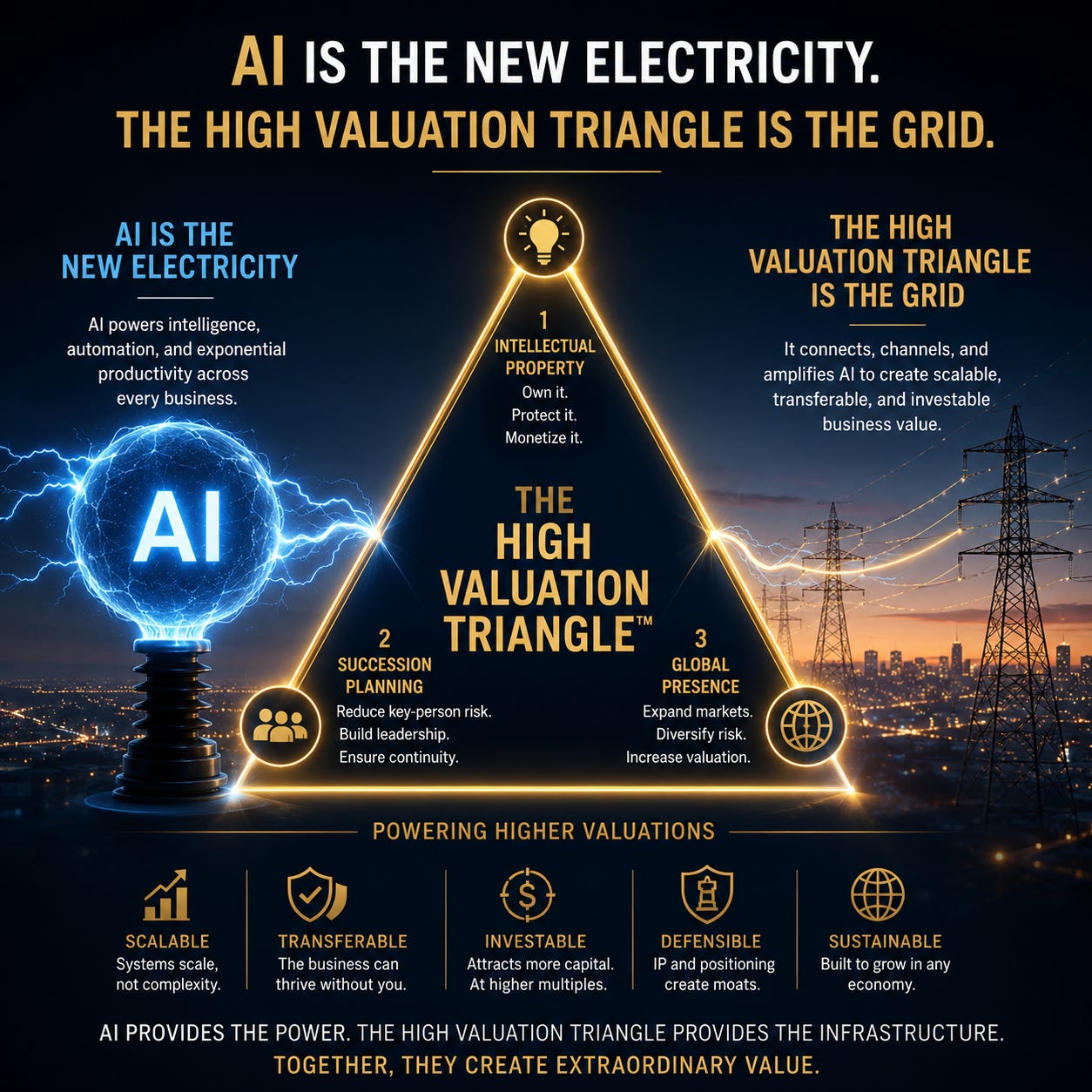
This is why Fail. Pivot. Scale. focuses heavily on what we call the High Valuation Triangle:
Intellectual Property
Succession Planning
Global Presence
These are not abstract concepts.
They are structural drivers increasingly influencing valuation in modern economies.
Failure Is No Longer The End. It Is Infrastructure
The title Fail. Pivot. Scale. was chosen deliberately.
Because the traditional linear narrative of business success is becoming obsolete.
In AI economies, adaptation speed matters more than perfection.
The companies that survive may not necessarily be the companies that avoid failure.
They may be the companies capable of learning, repositioning and scaling faster than competitors.
This requires a completely different mindset.
Failure becomes information.
Pivoting becomes strategy.
Scaling becomes architecture.
And architecture increasingly determines enterprise value.
The New Invisible Economy
One of the great paradoxes of modern capitalism is that the most valuable drivers of enterprise value are often invisible.
Culture.
Systems.
Brand positioning.
Algorithms.
Leadership structures.
Operational intelligence.
Data.
Networks.
Decision frameworks.
These assets rarely appear properly on balance sheets.
Yet they increasingly determine market dominance.
This creates a dangerous disconnect.
Many businesses still measure themselves primarily through historical accounting frameworks designed for industrial economies.
But the economy itself has already evolved.
The consequence is that many companies underestimate both their vulnerabilities and their opportunities simultaneously.
Why This Book Was Written
Matteo Turi and Simon Bedros wrote Fail. Pivot. Scale. because too many businesses are still preparing for the future using assumptions from the past.
The book combines decades of experience across:
Corporate finance.
M&A.
Valuation strategy.
Operational transformation.
Investor positioning.
Business scaling.
But fundamentally, the book asks a much bigger question:
What kind of businesses will survive the next economic era?
Because the economy being built now may reward very different characteristics from the one most founders were trained to navigate.
About The Authors
Matteo Turi is a CFO, board director and creator of the High Valuation Triangle framework developed in collaboration with Plymouth University in 2017. His work focuses on helping businesses become more scalable, transferable and investable in AI driven and intangible economies.
Simon Bedros brings deep expertise across corporate finance, investment strategy and business transformation, with a strong focus on helping founders navigate scale, restructuring and investor positioning.
Together, they combine valuation architecture with strategic execution to address one of the defining economic transitions of the modern era.
Final Thought
The industrial economy rewarded ownership of physical infrastructure.
The AI economy increasingly rewards ownership of scalable intelligence.
And many businesses still do not fully understand the difference.
That may become one of the defining competitive problems of the next decade.


