
Editorial Note
For years, founders believed capital followed growth.
If revenues increased, teams expanded and momentum accelerated, investment would eventually arrive. Banks would gain confidence. Investors would compete for access. Valuations would rise naturally.
That logic is beginning to break down.
Across industries, a growing number of businesses are discovering a deeply uncomfortable reality: they are working harder than ever while becoming less investable at the same time.
This week on The High Valuation Code, Francisco Gaffney and I explored one of the most misunderstood questions in modern business:
Why does capital say no?
Not publicly.
Not directly.
But quietly.
The hesitation often appears subtle.
“Come back in six months.”
“We need more visibility.”
“It is not quite the right timing.”
“We need to see more maturity in the structure.”
Most founders interpret this emotionally. They assume the market does not understand their vision.
In reality, capital is asking a different question entirely:
Can this business survive scale, uncertainty and AI-driven disruption without collapsing under its own complexity?
That changes everything.
The dangerous illusion of modern business
AI has created a paradox.
It has become dramatically easier to look sophisticated.
A business can now generate polished branding, automated marketing, AI-generated content, dashboards and customer communications in days rather than years. To the outside world, many companies appear larger, faster and more advanced than ever before.
But AI has also raised the standard for credibility.
Because if every business can appear impressive, investors must look deeper.
Presentation no longer creates confidence.
Structure does.
This is why so many businesses feel trapped between visible activity and invisible hesitation.
Revenue grows.
Teams work harder.
Content increases.
Meetings multiply.
Yet something still feels fragile.
Capital sees that fragility immediately.
Revenue is not strength
One of the biggest misconceptions in entrepreneurship is the belief that revenue equals resilience.
It does not.
A business can generate millions while remaining dangerously dependent on:
One founder
One relationship
One operational bottleneck
One major customer
One exhausted leadership team
To the founder, this may feel manageable.
To investors, it feels risky.
Capital is not underwriting this month’s revenue.
It is underwriting the reliability of the future.
That distinction becomes even more important in AI-driven economies because AI accelerates separation.
Weak structures become exposed faster.
Strong structures scale faster.
The middle ground begins to disappear.
This is why the next decade may produce one of the largest valuation divides in modern business history.
Not between big and small businesses.
But between structured and unstructured businesses.
The invisible valuation crisis
Many businesses today do not have a sales problem.
They have an architecture problem.
The industrial-era economy rewarded effort, physical assets and operational intensity.
The intangible economy rewards transferability, predictability and systems.
Increasingly, value is no longer built primarily on buildings, machinery or inventory.
It is built on:
Operational architecture
Data systems
AI integration
Intellectual property
Leadership depth
Predictable execution
Scalable decision-making
This is precisely why so many businesses struggle to command stronger valuations despite growth.
Because the market is no longer valuing activity alone.
It is valuing certainty.
And certainty is structural.
The founder dependency trap
One of the most damaging hidden risks inside many businesses is founder dependency.
Ironically, the founder often becomes both the reason for growth and the reason valuation compresses.
If the business cannot operate independently from one individual, investors immediately see fragility.
This matters enormously in AI-driven economies because AI rewards scalability rather than heroic effort.
Many founders still operate businesses powered by exhaustion instead of systems.
But exhaustion does not scale.
And capital increasingly recognises the difference.
The future belongs to businesses capable of functioning with clarity, repeatability and resilience even under pressure.
The next economic divide
We are entering a period where three massive shifts are colliding simultaneously:
AI-driven economies
The rise of intangible valuation
An unprecedented expansion of private capital globally
Together, these forces are rewriting how businesses are judged.
Capital is not disappearing.
But confidence is becoming harder to earn.
The businesses that understand this early could accelerate rapidly over the next decade.
The businesses that delay may slowly become invisible.
Not because they lack talent.
But because they were never engineered to become structurally investable.
Fail. Pivot. Scale.
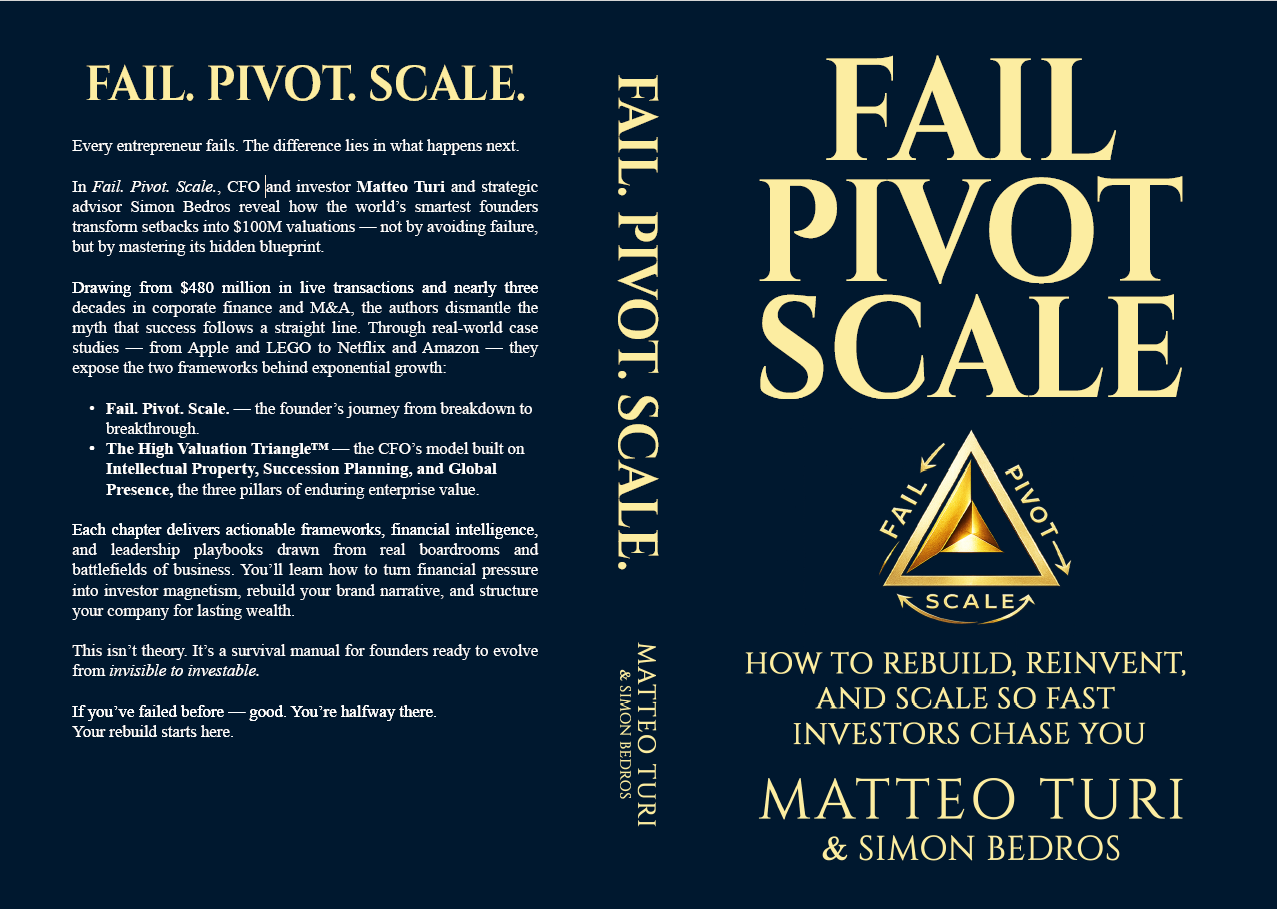
This is one of the core reasons I wrote Fail. Pivot. Scale.
Because most founders do not need more motivation.
They need visibility.
They need frameworks capable of identifying structural weaknesses before the market discovers them first.
Once investors identify fragility, valuation compresses.
Once founders identify fragility early and resolve it structurally, valuation expands.
That gap is enormous.
This is also why I am making available the 12 Outcomes in 49 Days scorecard and diagnostic framework.
The objective is simple:
To help businesses identify the hidden gaps reducing valuation, slowing investment confidence and weakening scalability in AI-driven economies.
Because the businesses that thrive in the next decade will not necessarily be the loudest businesses.
They will be the businesses that become impossible to ignore.
The AI economy will not wait for businesses to catch up.
And increasingly, neither will capital.
Matteo Turi
Author of Fail. Pivot. Scale.
Creator of the High Valuation Triangle


